In high school math, you might have learnt a trick for evaluating integrals like
$$\int{1\over x^2+3x+2}.$$ This trick is called partial fractions, and it involves rewriting the fraction as a sum of simpler fractions whose integrals are already known. In this case, $$\begin{align*} \int{1\over x^2+3x+2} &= \int{1\over(x+1)(x+2)} \\ &= \int\left({1\over x+1}-{1\over x+2}\right) \\ &= \int{1\over x+1}-\int{1\over x+2} \\ &= \ln|x+1| - \ln|x+2| + C. \end{align*}$$ The same trick can be applied to more complicated expressions. For instance, $$\begin{align*} \int{x^5+11x^4+50x^3+114x^2+132x+66\over x^6+14x^5+80x^4+238x^3+387x^2+324x+108} &= \int{1\over x+1}-\int{2\over(x+2)^2}+\int{3\over(x+3)^3} \\ &= \ln|x+1|+{2\over x+2}-{3\over2(x+2)^2}+C. \end{align*}$$ Naturally, one should ask if this trick always applies to an expression of the form $\text{(polynomial)}/\text{(polynomial)}$, called a rational function. The answer is yes! Specifically, I will show in this post that every rational function can be written as a sum of a polynomial and partial fractions of the form $$\begin{equation}\label{1}{A\over(x-B)^k} \quad\text{or}\quad {Ax+B\over(x^2+Cx+D)^k}. \end{equation}$$ The former is easy to integrate via the power rule, while the latter is more difficult but can be tamed by standard substitutions. (I might go through this in a future post.) I recommend skipping to the worked example to see the procedure in action, then consulting the preceding text for theoretical justifications.|
|
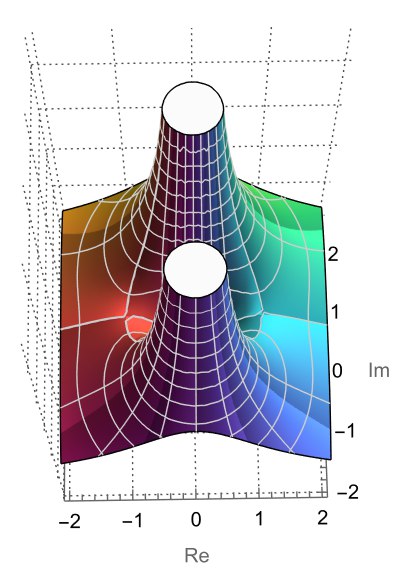
| Figure 1. |
$P(z)$ cannot be expanded as a power series around $c$ — if it could, then evaluating at $c$ gives $a_0+0+0+\ldots$ which is infinite, contradicting the fact that $c$ is a pole. $$(z-c)^kP(z) = a_0 + a_1(z-c) + a_2(z-c)^2 + \ldots$$ Dividing both sides by $(z-c)^k$ gives us a helpful new way of looking at $P(z)$: $$\begin{equation}\label{2}P(z) = a_0(z-c)^{-k} + a_1(z-c)^{-k+1} + a_2(z-c)^{-k+2} + \ldots\end{equation}$$ Now, we see that $P(z)$ blows up at $c$ due to the terms where $(z-c)$ appears in the denominator: $$a_0(z-c)^{-k}+a_1(z-c)^{-k+1}+\ldots+a_{k-1}(z-c)^{-1}.$$ Subtracting away these terms leaves us with the series $$a_k + a_{k+1}(z-c) + a_{k+2}(z-c)^2 + \ldots,$$ which approaches the finite value $a_k+0+0+\ldots$ when $z\to c$ — no more pole! (Notice that we've cancelled a pole two different ways.)
The polynomial is zero only when the degree of numerator $<$ degree of denominator of $P(z)$, by a straightforward degree argument. We can reduce any rational function to this case by polynomial dividing the numerator by the denominator.
$$P(z) - \sum_{i=1}^{k_1}{a_{1i}\over(z-c_1)^i} - \ldots - \sum_{i=1}^{k_n}{a_{ni}\over(z-c_n)^i} = p(z).$$ Bringing all the sums to the right side, we actually get something very close to the partial fraction expansion of $P(z)$. The snag is that the $c_i$'s are complex, but when our $P(z)$ is real, we also want the partial fractions to be real. We can fix this with some work, using the fact that the roots $c_1,\ldots,c_n$ come in conjugate pairs, i.e. if $c$ is a root then $\overline c$ is also a root with the same order Thus, for any non-real $c$ we can group the negative-power terms for $c$ and $\overline c$ in pairs:If $p(x)$ is a real polynomial and $p(c)=0$, then $0=\overline{p(c)}=p(\overline c)$, where the second equality holds because the coefficients are real. Furthermore, $c,\overline c$ have the same order in $p(x)/(x-c)(x-\overline c)$ by induction.
$$\begin{align*}\sum_{i=1}^k{a_i\over(z-c)^i} + \sum_{i=1}^k{b_i\over(z-\overline c)^i} &= \sum_{i=1}^k {a_i\over(z-c)^i}+{b_i\over(z-\overline c)^i} \\ &= \sum_{i=1}^k {a_i(z-\overline c)^i+b_i(z-c)^i\over (z^2-2\Re(c)z+|c|^2)^i}. \end{align*}$$ Note that the denominator has real coefficients. However, we are not done because looking at \eqref{1}, the numerators have to be linear. To achieve this, we do a polynomial division ofIf $p(z)$ and $q(z)$ are polynomials, then polynomial division refers to writing $p(z)=a(z)q(z)+r(z)$ where $\deg r<\deg q$. This is an analogue of integer division, where the dividend is expressed the quotient times the divisor, plus the remainder.
$$a_i(z-\overline c)^i+b_i(z-c)^i \quad\text{by}\quad z^2-2\Re(c)z+|c|^2,$$ thus obtaining $${p(z)\over (z^2-2\Re(c)z+|c|^2)^{i-1}} + {Az+B\over(z^2-2\Re(c)z+|c|^2)^i}.$$ The coefficients $A,B$ can be shown to be real and the first term is a sum of terms of the second type in \eqref{1} by induction. Thus,The polynomial $a_i(z-\overline c)^i+b_i(z-c)^i$ has real coefficients because $b_i=\overline{a_i}$. This follows from the power series identity $\overline{P(z)(z-c)^k}=P(\overline z)(\overline z-\overline c)^k$.
$$\sum_{i=1}^k {a_i(z-\overline c)^i+b_i(z-c)^i\over (z^2-2\Re(c)z+|c|^2)^i}$$ is overall a sum of terms of the second type in \eqref{1}. Finally, repeating this combining process for all pairs of conjugate roots $c,\overline c$ gives us the result at \eqref{1}.A computer algebra program like Mathematica helps a lot for these computations.
$$P\left(1/z+1\right) = {z^5+4z^4+6z^3+4z^2+z\over 4z^4+8z^3+8z^2+4z+1};$$ dividing the numerator by the denominator gives a quotient of $z/4+1/2$. Therefore $a_0=1/4$ and the partial fraction corresponding to $z=1$ is $1/4(z-1)$. Similarly for $z=i$ we have $$P\left(1/z+i\right) = {iz^5+4z^4-6iz^3-4z^2+iz\over (4+4i)z^3+(4-8i)z^2-(5+i)z+i},$$ and the quotient is $(1/8+i/8)z^2+(3/8-i/4)z+(-1/32-9i/32)$, so the partial fractions corresponding to $z=i$ are $${{3\over8}-{i\over4}\over z-i} + {{1\over8}+{i\over8}\over(z-i)^2}.$$ The same computation could be done for $z=-i$, but actually we can save all the work by noting that the coefficients are simply conjugated: $${{3\over8}+{i\over4}\over z+i} + {{1\over8}-{i\over8}\over(z+i)^2}.$$ Putting all the partial fractions together gives us $$P(z) = {1/4\over z-1} + {{3\over8}-{i\over4}\over z-i} + {{1\over8}+{i\over8}\over(z-i)^2} + {{3\over8}+{i\over4}\over z+i} + {{1\over8}-{i\over8}\over(z+i)^2}.$$ If we insisted on only having real numbers, then the terms $1/(z\pm i)$ and $1/(z\pm i)^2$ need to be combined. Adding the $1/(z\pm i)$ terms: $${{3\over8}+{i\over4}\over z+i} + {{3\over8}-{i\over4}\over z-i} = {3z/4+1/2\over z^2+1};$$ the right-hand side fraction has the form $(Az+B)/(z^2+Cz+D)^k$ so we are done. As for the $1/(z\pm i)^2$ terms: $${{1\over8}-{i\over8}\over(z+i)^2} + {{1\over8}+{i\over8}\over(z-i)^2} = {z^2/4-z/2-1/4\over(z^2+1)^2}.$$ The numerator is not linear, so divide $z^2/4-z/2-1/4$ by $z^2+1$ to get the quotient $1/4$ and remainder $-z/2-1/2$. Then we split the right-hand side fraction as $${1/4\over z^2+1} + {-z/2-1/2\over(z^2+1)^2}.$$ Adding up the $1/(z^2+1)$ and $1/(z^2+1)^2$ terms, we finally obtain the real partial fraction expansion $$P(z) = {1\over 4(z-1)} + {3\over4}{z+1\over z^2+1} - {1\over2}{z+1\over(z^2+1)^2}.\;\qed$$